
You're viewing an archived page from a previous Festival of Ideas. See this year's festival »
Discovery Zone
Event details
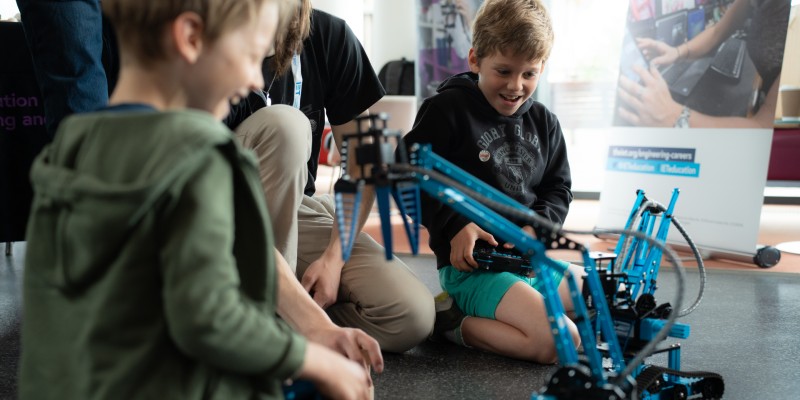
Join us for some family fun as we spark children’s imaginations with a range of hands-on, interactive activities. Step back in time to discover the remains of ancient villages, decorate a brain hat and have fun with numbers. Or maybe find out some fascinating facts about British animals or try on VR goggles?
Come along and meet York researchers and find out how their cutting-edge work is improving the world we live in.
Activities include:
Archaeological Rats!
Learn about a project looking at ancient rats found across Europe dating from the Iron Age to the post medieval period. As rats are so small, discover how researchers are using a range of different bioarchaeological techniques to identify them. Spot skeletal differences between black and brown rats and have a go at making a molecular species identification using protein or DNA markers. Sieve through sand to find 3D printed bones and leave us with your own Young Zooarchaeologist Passport.
Fresh Air, Fresh Roots
Step into our hands-on 'miniature room' to explore the air around us. Try raising CO₂ with just your breath and a straw, track your score, and discover why air quality matters and how small actions at home can help.
From Stars to Medicine: Investigating nuclear physics
Explore nuclear physics using our giant LEGO chart, with 30,000 LEGO bricks! Discover how the process that powers the stars is being developed as a new, clean energy source here on Earth; use detectors to 'see' radiation; and learn about how nuclear medicine can be life saving.
Fun with Numbers
How good is your number sense? Does the language you speak influence your number skills? Why are fractions so hard? Come and try some hands-on activities with researchers from the Numerical Cognition Lab at the University of York’s Department of Psychology. Find out the answer to these questions and more!
How Does a University Find its Future Source of Energy?
Discover how the University of York is in search of a long term sustainable source of heat and electricity for the University campus. Could that future source lie beneath your very feet right now? Learn about the deep geology of York and how we are going about making use of the energy that lies there.
How Scientists Use Light to Detect Disease
Our bodies hide clues about our health in snot, tears, sweat and blood. Find out how scientists from the Universities of York, Strathclyde, and Cambridge are working together to build new machines that use light to detect disease faster, cheaper and more effectively than ever before. Discover how we make biosensors from gold, make them tiny and use special cameras to take pictures with more colours than our eyes can see.
Life on the Lakeshore: Plants in prehistory
Step back in time to discover the remains of ancient villages dotted along the shores of the Alpine lakes. Over 5000 years ago, prehistoric people lived above water in small wooden houses, harvesting, collecting and cooking many different plants. In this hands-on activity, follow the steps of an archaeologist analysing ancient plants to explore how villagers used plants for food, shelter and more.
Medieval Mediterranean: Cuisines and cultures
Explore the intersection of food and culture in Iberia during the Medieval Period. Learn how we use ancient animal DNA, stable isotopes, food residues on pottery and ancient plant remains in archaeological studies. Medieval Spain was home to people from many different cultures – follow the clues to find out how these people were living, eating and trading together.
Psych!York
Look out for activities including VR goggles, optical illusions, brain-hat decoration and build-your-own-neuron kits. This is your chance to learn more about psychological research and discoveries being made at York.
What Kind of Archaeologist Are You?
How good are you at matching archaeological items to the places they were found? Try out this and other interactive games showcasing different aspects of archaeology. Don’t forget to take home a sticker of your favourite kind of archaeology.
Image credit: Alex Holland, University of York
Partners